Author: kellirodriguez

  • What a Last-Minute Visit Taught Me About Building Trust

    What a Last-Minute Visit Taught Me About Building Trust

    What a Last-Minute Visit Taught Me About Building Trust

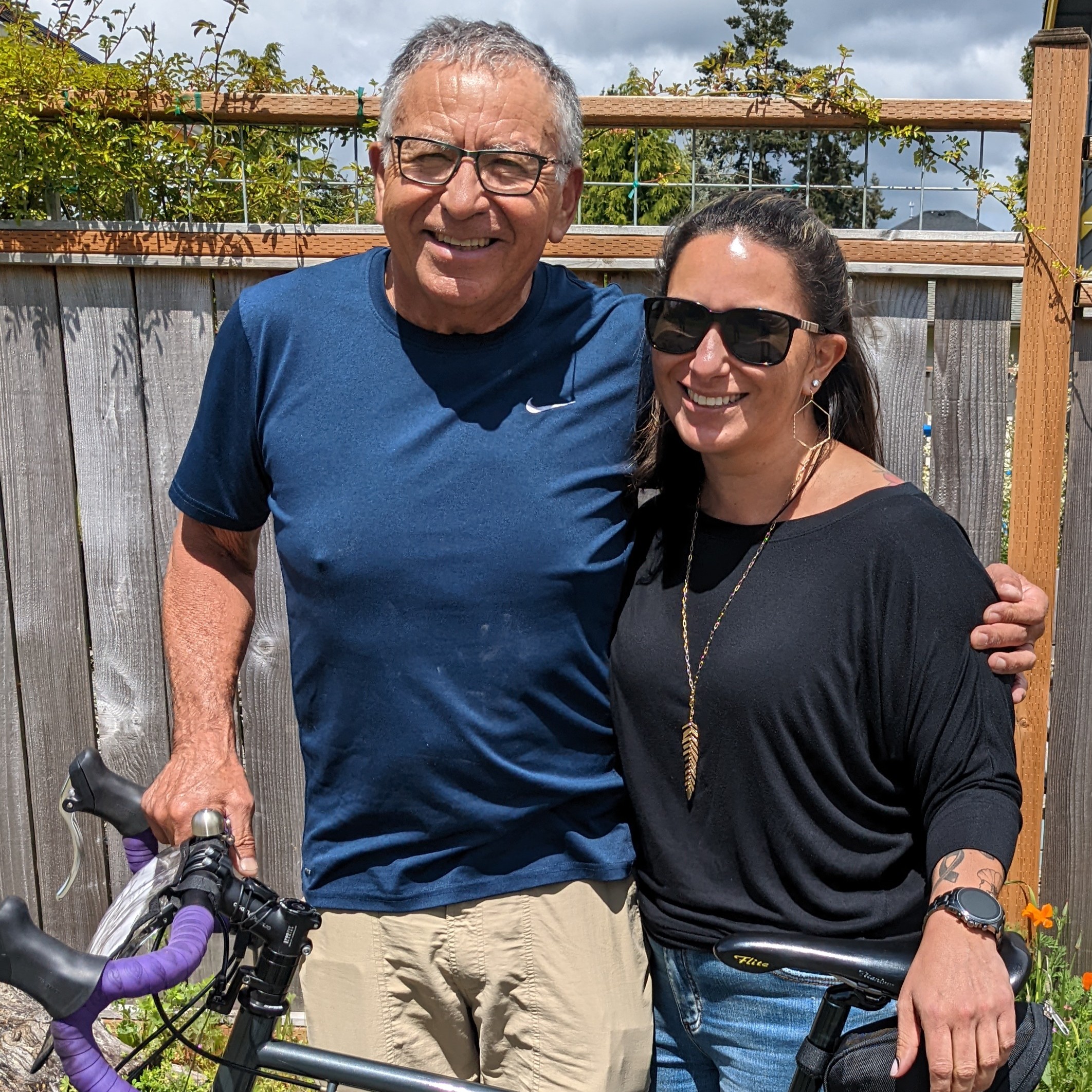
    Kelli and her dad.

    My dad called me Saturday to say he had “a surprise.” He had flight credit expiring Monday, and he’d be flying up the next day, Sunday.

    I said yes without hesitation, and spent the rest of the weekend quietly rearranging my week: a few meetings moved, a few things got delegated. I picked up my dad Sunday evening and had an email scheduled to send on Monday morning.

    “My dad surprised me with a last-minute visit, so I’m taking a couple of days to be with him.”

    Nobody blinked. My husband didn’t blink when I told him my dad would be arriving in less than 24 hours. My colleagues didn’t blink when I stepped away with almost no notice.

    I know my work is flexible in ways many people’s aren’t, and I don’t want to minimize that privilege. But flexibility on paper is fundamentally different than a culture that actually makes room for you to enjoy it. Plenty of people have generous PTO policies and still feel like they need to justify, hedge, or apologize before they take the time. What made this different wasn’t the policy. It was the trust underneath it: the trust that allowed me send one honest sentence and know it would be enough.

    My mom passed several years ago, and I lost my cousin far too young; both of those losses serve as a quiet, steady reminder that none of us are guaranteed the next visit, the next call, the next ordinary Tuesday together. When an opportunity like this shows up, unplanned and inconvenient, worth it, I’ve learned that leaning in matters more than protecting my schedule.

    But leaning in only works if the people around you make it possible.

    As a leader, I think about what it actually takes to cultivate that kind of space within a team:

    • A safe space that lets someone share who and what matters to them.
    • A collaborative space where colleagues genuinely want to pitch in when someone steps away, not because they’re told to, but because they trust it will be reciprocated.
    • A trusting space that runs both directions, so that when someone takes those days, the people around them know they’ll show up fully when they return.

    None of that happens by accident, and none of it happens overnight. Safe, collaborative, and trusting spaces are built in the small moments: when a request is met with curiosity instead of quiet judgment, and when “family emergency” and “family joy” are afforded the same grace.

    I didn’t get to spend a few impromptu days with my dad because an airline was about to expire his flight credit. I got to enjoy a few days with him because collectively, our entire staff has spent years quietly and intentionally building a culture that didn’t require me to choose between showing up for my team and showing up for him.

    That’s the leadership I aspire to, and the culture I hope to leave behind. Not because it makes people more productive, though it probably does, but because it makes room for the parts of life that actually matter. The people who show up on short notice. The visits you can’t plan for. The time that, sooner or later, all of us wish we’d taken.

  • Why Alpha Chi?

    Why Alpha Chi?

    Why Alpha Chi?

    Alpha Chi Omega National Vice President badge

    I never planned to join a sorority: I certainly never imagined being a late-forties, National Vice President kind of sorority girl. But if I could give that young 18-year-old a glimpse of what Alpha Chi Omega will bring her, I’d ask her simply to be open to what may be the biggest surprise of her life.

    more than friendship

    I’ve found friends who welcomed me to new cities through two cross-country moves, friends who rallied around me through cancer treatment, and women who sat with me through divorce. We’ve parented together, vacationed together, and grieved together. I’ve met people from every corner of our country and across generations, and I’ve learned that so much more brings us together in community than divides us.

    These women have changed me. They have pushed me and lifted me up. They haven’t made me into a sorority girl, they have embraced me for all that I bring to sorority.

    more than volunteering

    I’ve learned to distinguish a profit and loss statement from a balance sheet. I am more practiced and more comfortable speaking publicly. I’m confident leading committees and boards, engaging with wide audiences of people, and mentoring those around me. The leadership opportunities I’ve had as an alumnae volunteer have given me countless tangible skills that I use every day in my personal and professional life.

    These opportunities have changed me. They have challenged me to step outside my comfort zone and provided the space to practice new skills.

    more than sorority

    I never planned to join a sorority because I never knew what sorority could be.

    Why Alpha Chi?
    Because it continues to be the biggest surprise of my life.

    I never imagined I’d find my longest friendships or engage in volunteer experiences that were so applicable to my work. I didn’t expect to find leadership training well into mid-career, networking opportunities as I moved industries, or mentorship in my volunteer service.

    I give back because I believe in the experiences and opportunities that Alpha Chi Omega provides. I volunteer because I know firsthand how life-changing it can be to feel seen, supported, and empowered. I stay connected because I hope to be part of someone else’s story: to encourage another woman to take a chance on sorority and let it change her.

  • What radiation treatment taught me about leadership.

    What radiation treatment taught me about leadership.

    What radiation treatment taught me about leadership.

    Everyone is carrying something.

    Everyone is carrying something we cannot begin to understand. If we are lucky, they only carrying one single thing. Many of us are carrying so, so much more.

    I work across the street from the cancer center where I received my final radiation treatment just over five years ago. Every day for twenty days, I walked up to the corner of campus and across the street, through the large sliding doors, and down the eerily long hallway to the brightly lit corridor at the end. I walked past women in wheelchairs: scarves wrapped around their bare scalps.

    I checked in, went to the back room and changed: top off, gown open in the front. A half-hour later, I dressed again and returned back down the long hallway, past more wheelchairs and more scarves. The wristband I wore during treatment reminded me that I was one of them. I crossed the street and stepped back onto campus: back to my life.

    I was quieter during those few months. Less engaged, less fun, less me. I didn’t mind sharing what I was going through; I simply had no idea how to articulate the confusion of it all. My skin was cracking from radiation burns; peeling off and raw. My arm chafed when it rested against my sidebody. I was in pain, almost all of the time, and I had no idea what was happening or when it would end.

    “I’ll be okay,” I was certain. But between radiation oncology and medical oncology, my marriage was unraveling, my mother was declining, and my teenagers were teenag-ing. My world was so heavy, and life had become so. incredibly. much.

    Everyone is carrying something. In good moments, they may have the words to tell you what they’re carrying. In great moments, they may even be able to tell you how it feels for them.

    I’m grateful that I felt safe enough to share so much of my cancer journey; thankful I could share my confusion and emotion with so many people along the way. But I’m not sure I’ll ever be able to explain how it felt to walk back to work each day after treatment: feeling both incredibly lucky to be strong enough to walk at all, while also completely terrified by the process.

    As leaders, it’s not our job understand what people are carrying. It is not our role to pry it out of them. It is simply our work to hold space for the certainty that every single person we lead is carrying something that they may not share, we may not see, and we will never fully understand.

  • Happy New Year: 5 years cancer-free.

    Happy New Year: 5 years cancer-free.

    Happy New Year: 5 years cancer-free.

    Cancer ribbon tattooed on left arm.

    On January 18th, 2019, I had my last radiation treatment for ductal carcinoma in situ (DCIS): breast cancer. Being diagnosed at 36, even with Stage 0 breast cancer, felt like my world had started to crumble around me. I had lost my mom to breast cancer only four years before, and had been terrified of getting my first mammogram for an entire year before the diagnosis.

    Regardless, it rocked my entire world.

    When you are treated for cancer, the first day after your last “active” treatment is your first day in survivorship. Active treatments include surgeries, chemotherapy, and radiation, and while tamoxifen is considered treatment, it’s passive, so the countdown to anniversaries begins after you complete your active treatments.

    The last five years of passive treatment haven’t been much more forgiving, unfortunately.

    The five-year threshold is a milestone along any cancer journey. At five years post-diagnosis, the chance of recurrence reduces significantly – mine will be less than 3% starting tomorrow. Through the worst of it, dozens of people reminded me that I would feel like myself again; in five years, I was told, “all of this will feel like a bad dream.” As the years have ebbed and flowed, I’ve learned that I won’t feel like my old self again, because she has become someone who has lived through this. But, as I step into my fifth year of cancer survivorship, I can’t help but feel emotional knowing how far I’ve come, and how close I am to it all just being a bad dream.

    And though my breast cancer journey will always be a backdrop in my story — always coloring the world around me and the way I interact with it — it will not always be in focus. I will continue to live and thrive and make memories with my favorite humans. I will continue to love fiercely, and dance poorly, and travel often. I will continue to adventure bravely with my arm raised high.